Weekly Modules
The six-week structure moves participants from conceptual foundations to hands-on analysis, interpretation, figure generation and scientific writing.
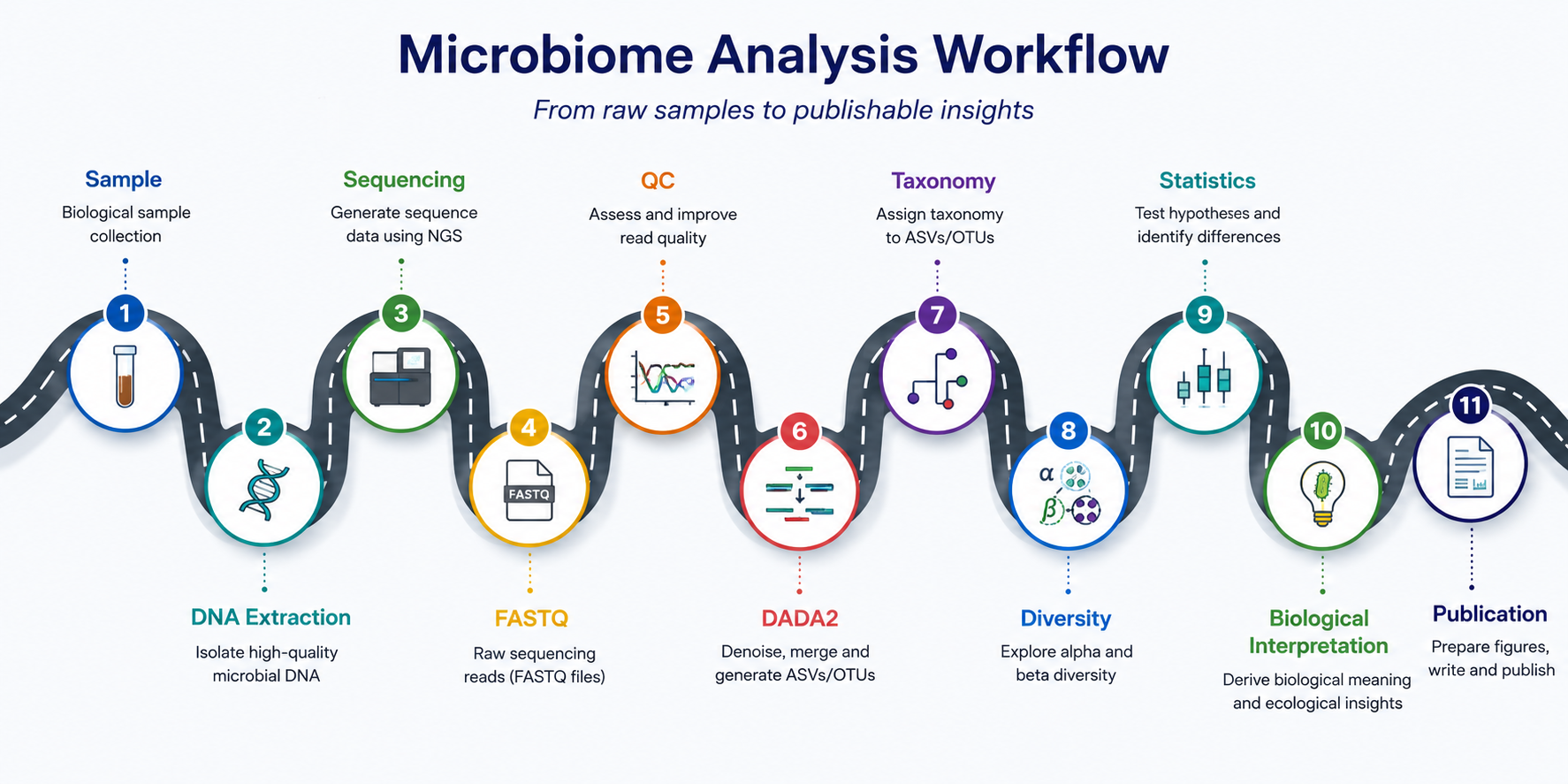
A guided, HDR-aligned learning journey from raw sequencing data to publishable microbiome insights.
Six-Week Learning Journey
The modules are organised to progressively develop microbiome analysis skills — from sequencing workflows and quality control to taxonomy, diversity analysis, statistical interpretation and scientific communication.
The Microbiome & How We Study It
This session introduces the conceptual foundations of microbiome research and sequencing-based analysis.
By the end of this module participants will be able to:
- Define microbiome terminology and ecological concepts
- Explain the principles of 16S rRNA sequencing
- Differentiate amplicon and shotgun metagenomics workflows
- Interpret FASTQ files and sequencing outputs
Two Bioinformatics Workflows
This session introduces amplicon sequencing analysis and shotgun metagenomics workflows.
By the end of this module participants will be able to:
- Understand microbiome data structures and metadata
- Interpret microbiome experimental design requirements
- Explain QIIME2 and DADA2 analytical workflows
- Select appropriate microbiome analytical approaches
Quality Control & Data Preparation
Participants begin practical microbiome analysis using QIIME2 and example sequencing datasets.
By the end of this module participants will be able to:
- Interpret FASTQ quality profiles
- Import sequencing data into QIIME2
- Conduct trimming and filtering of reads
- Document quality-control decisions reproducibly
From Reads to Taxonomy
Participants perform denoising, ASV generation and taxonomic classification.
By the end of this module participants will be able to:
- Perform DADA2 denoising workflows
- Generate Amplicon Sequence Variants (ASVs)
- Interpret feature tables and taxonomy outputs
- Visualise microbial taxonomic composition
Microbiome Diversity, Statistical Testing & Biological Interpretation
Participants learn statistical approaches for microbiome diversity analysis and interpretation.
By the end of this module participants will be able to:
- Interpret alpha and beta diversity analyses
- Generate ordination plots (PCoA/NMDS)
- Conduct PERMANOVA statistical testing
- Interpret differential abundance outputs
Reproducible Reporting, Visualisation & Scientific Communication
The final workshop integrates analytical outputs into publication-ready scientific narratives.
By the end of this module participants will be able to:
- Generate publication-quality microbiome figures
- Customise microbiome visualisations in ggplot2
- Draft microbiome Methods and Results sections
- Assemble analytical outputs into coherent research stories