Schedule
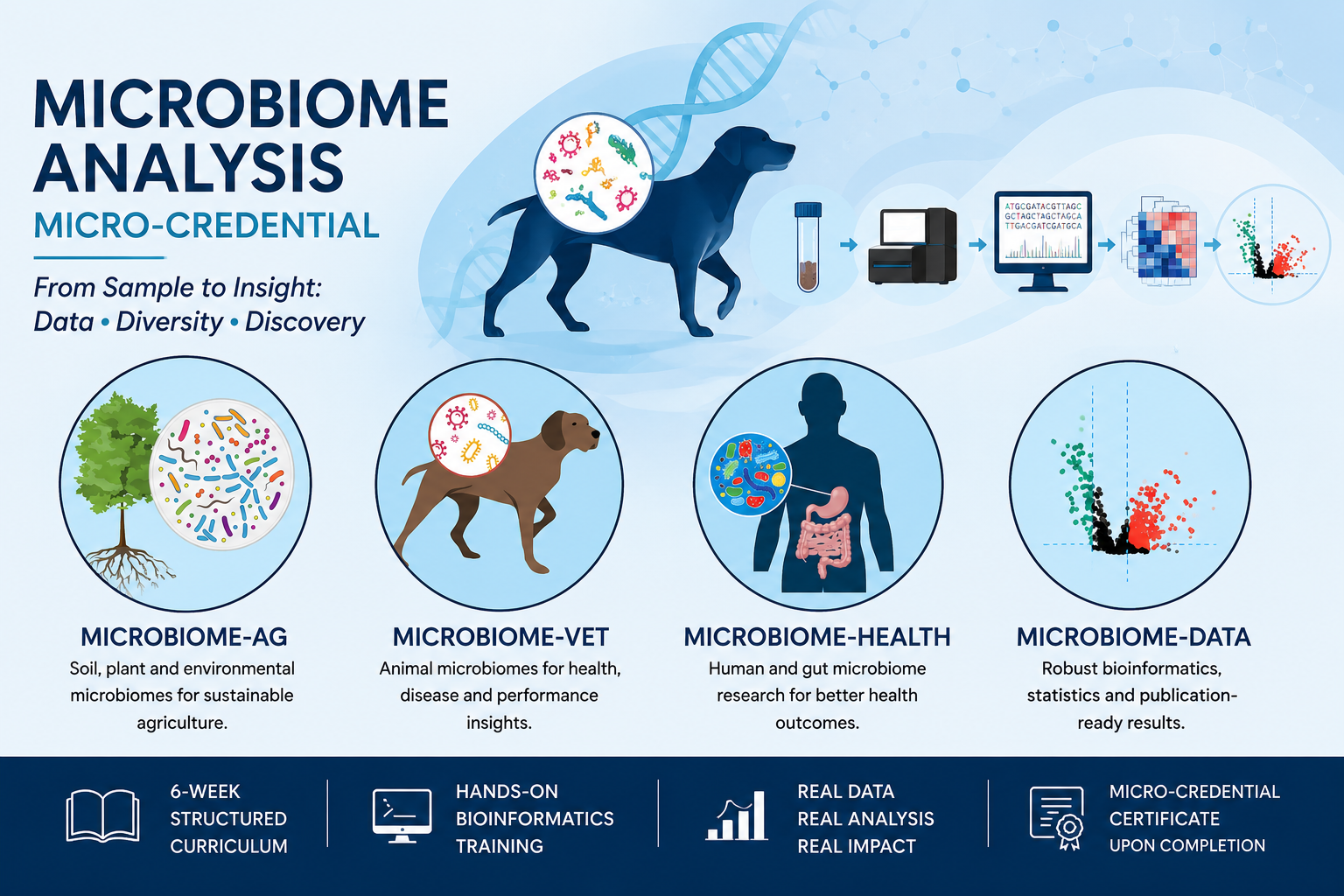
All sessions are part of the Microbiome Analysis Micro-credential.
Assessment & Completion
Participants are expected to engage with the weekly learning activities, practical workshops and final research-focused microbiome analysis task.
- Attend weekly sessions
- Complete weekly quizzes and feedback activities
- Participate in hands-on microbiome analysis exercises
- Complete a final microbiome mini-project using a real or example dataset
Participants who meet the completion requirements receive a Certificate of Completion.
Week 1: The Microbiome & How We Study It
| Week 1 | Theory |
|
Suggested Reading
- QIIME2 documentation: Introduction to microbiome analysis
- Nature Reviews Microbiology article on microbial ecology or microbiome research
- Selected microbiome case study relevant to agriculture, health or environmental science
Week 2: Bioinformatics Workflows for Microbiome Analysis
| Week 2 | Theory |
|
Suggested Reading
- QIIME2 documentation on importing sequence data and metadata
- DADA2 workflow tutorial or overview paper
- Review article comparing amplicon sequencing and shotgun metagenomics
Week 3: Quality Control & Data Preparation
| Week 3 | Hands-on Workshop |
|
Suggested Reading
- QIIME2 documentation on sequence quality control
- FASTQ quality score guide or sequencing QC tutorial
- Best-practice guide on metadata preparation for microbiome studies
Week 4: From Reads to Taxonomy
| Week 4 | Hands-on Workshop |
|
Suggested Reading
- DADA2 paper or denoising workflow tutorial
- QIIME2 documentation on feature tables and taxonomy classification
- SILVA database overview or taxonomy reference documentation
Week 5: Microbiome Diversity, Statistical Testing & Biological Interpretation
| Week 5 | Hands-on Workshop |
|
Suggested Reading
- QIIME2 documentation on diversity analysis
- Introductory guide to alpha diversity and beta diversity in microbiome studies
- Tutorial or review article on differential abundance analysis for microbiome data
Week 6: Reproducible Reporting, Visualisation & Scientific Communication
| Week 6 | Hands-on Workshop |
|
Suggested Reading
- ggplot2 visualisation resources for biological data
- Example microbiome manuscript with clear Methods and Results reporting
- Guidance on reproducible research and scientific figure preparation